

Welcome to Bristlemoon Capital! We have written previously on Google’s ROI, ASML, IFX GY, AERO SW, AER, ADBE, TDG, the AI bubble, FICO, GOOGL, ASML, SNPS, UNH, META, GRND, HEM SS, MELI, U, APP, PDD, IBKR, PAR, AER, PINS, BROS, MTCH, CPRT, RH, EYE, and TTD.
If you haven’t subscribed, you can join 6,420 others who enjoy our deep dives and investment insights here:
Wholesale investors looking to invest in the Bristlemoon Global Fund can do so via this link.
It has been a while since we’ve written publicly about a Bristlemoon short, the last writeup of which was for National Vision Holdings (EYE) back in January 2024. However, it has been for an even longer period that we’ve been itching to short U.S. department stores. While the likes of Macy’s and Kohl’s might be household names, from a business standpoint they’re melting ice cubes, with their revenues and earnings shrinking each year. However, since the inception of the Fund, we have demurred from shorting these embattled department store retailers. They always looked dangerously cheap, and we lacked a divergent view. This has now changed, and we have recently initiated shorts in Macy’s (M) and Kohl’s (KSS).
N.b.: the majority of the discussion will revolve around M, with only passing details provided on KSS.
Key takeaways
U.S. department stores remain melting ice cubes, but for the first time in years we think the valuation and earnings setup makes them attractive shorts. Macy’s and Kohl’s have spent the last decade shrinking, yet both have recently re-rated as operating trends have improved; M now trades at 10.5x earnings versus a five-year average of 6.6x.
We think the market is over-extrapolating Macy’s recent comp improvement. The Reimagine strategy has worked, but 200 refreshed stores already represent ~60% of the go-forward store base and ~75% of Macy’s nameplate sales, meaning much of the low-hanging fruit has already been picked just as the company begins lapping tougher comparisons.
Macy’s headline profitability also flatters the health of the underlying retail business. Credit-card revenues equated to around three quarters of Macy’s FY25 adjusted EBIT, with recent growth benefiting from a normalization in funding costs and credit losses. That growth is already decelerating, while the card business adds another source of procyclicality if consumer credit deteriorates.
Meanwhile, transportation inflation represents a new margin headwind that investors may be underappreciating. On our illustrative assumptions, higher inbound truckload and outbound parcel costs could create roughly $115 million of incremental expense and reduce operating earnings by ~13%, before offsets. Putting these factors together, we can get to FY27E EPS of ~$1.50 in a bear case scenario, 35% below sellside consensus; at 8x earnings this implies a ~$12 share price, more than 50% below current levels.
Melting ice cubes
Consider that Macy’s sales growth has been negative in all but two of the past 10 years. Kohl’s topline performance has not been much better.

Source: Bristlemoon Capital; Company filings
U.S. department stores, in a bygone era, used to be excellent businesses. However, the advent of e-commerce has changed this, and the probability of shoppers reverting en masse to the old (analog) way of purchasing goods rounds down to zero.
M, somewhat tragically for those with nostalgic tendencies, has shuttered 41% of its Macy’s branded store base over the last decade. KSS, somewhat defiantly, has closed only 1% of its Kohl’s stores over that period, although the average revenue per store has fallen by one fifth over that decade span. However, these sales declines only tell half of the story.
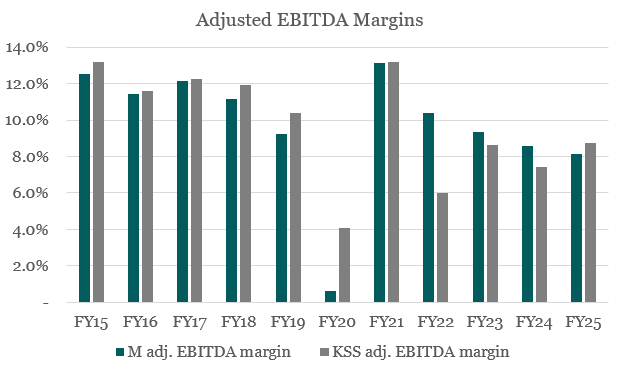
As one would expect with the sales deleverage on a fixed cost base, the margins of these department stores have also compressed, shedding roughly 4.5 percentage points over the last decade, falling from around 13% in FY15 to c.8.5% today.
Source: Bristlemoon Capital; Company filings
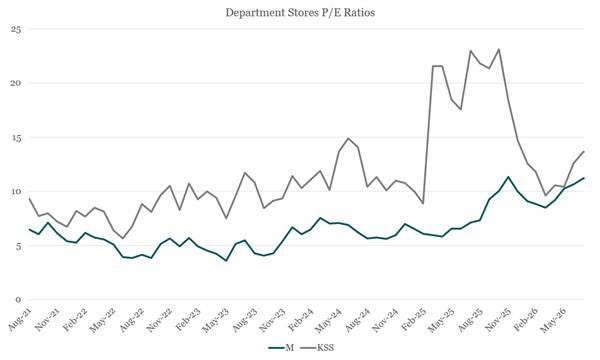
It’s fairly consensus that these are challenged businesses, and for years the companies traded at single-digit P/E multiples. However, more recently, both M and KSS have re-rated and are trading at a premium to where their multiples have hovered historically. M, for example, is trading at 10.5x P/E, a whopping 2.1 standard deviations above the average P/E over the last five years of 6.6x.
Source: Bristlemoon Capital; Bloomberg
So, what has led to the recent re-rate in these stocks?