

Welcome to Bristlemoon Capital! In this report, we examine FTAI Aviation and the economics of its engine exchange model. For more of our work on the aerospace industry, you may also enjoy our research on AerCap and TransDigm. Our archive has the full collection of published reports.
If you haven’t subscribed, you can join 6,527 others who enjoy our deep dives and investment insights here:
Wholesale investors interested in the Bristlemoon Global Fund can learn more here.
Introduction
If you’re reading this, chances are you’ve flown as a passenger on a commercial aircraft. Each trip, in aircraft industry parlance, is referred to as a cycle (i.e., a complete sequence of takeoff and landing). With enough flight hours and cycles, certain parts within an aircraft’s engine must be replaced. This is because with each cycle, there are changes in temperature, speed and load that can cause fatigue in critical engine components.
Thankfully, for safety reasons (and for the peace-of-mind for those that travel regularly), certain engine life-limited parts (LLPs) must be replaced when they reach their approved cycle limit, and this is mandated by FAA regulations. Historically, when the LLPs of an engine near their approved life limit, the engine would be sent to a maintenance, repair, and overhaul (MRO) shop for a rebuild. Much like if you were to drop your car off at a mechanic, the MRO would disassemble the aircraft engine, perform repairs, and then furnish the airline customer with a final bill (which is often higher than expected).
FTAI Aviation piqued our interest because its business model is a somewhat unique twist on the traditional MRO model used by the airline industry for decades. FTAI has commercialized what is referred to as a maintenance, repair, and exchange (MRE) program. So, instead of repairing and returning the airline’s own engine, FTAI swaps it for a refurbished replacement. This engine exchange can be done in just a few days, avoiding the up to 200 day wait time associated with an MRO repairing an engine. And by supplying a refurbished replacement engine, FTAI helps airlines reduce aircraft downtime and avoid the cost and complexity of arranging spare engines to keep a plane flying during an overhaul.
This has been a cracking success for FTAI. Consider that the company’s Aerospace Products adjusted EBITDA has grown from around $22 million in FY21 to $671 million in FY25, a 30x increase in just four years. Despite revenues that are expected to grow by 50% in FY26E and then by 69% in FY27E, and with earnings per share expected to grow even faster, the stock trades at a P/E ratio of just 15x.
FTAI Aviation is a business that was recently initiated in the Bristlemoon Global Fund, after the stock had fallen by more than 35% since its all-time high reached in February 2026. This is a rather complex business with even more complex accounting. What follows is our attempt to unpack some of the nuance in this business to help readers understand the business and its growth prospects. In particular, we try to drill into the core debates that matter for the stock.
Key Takeaways
FTAI has amassed hundreds of CFM56 engines and it also owns repair shops across the globe, making it the only company at scale to both own the engines and the repair shops. This allows FTAI to run an engine exchange program that drastically improves the turnaround time for its customers. These CFM56 engine modules can also be mixed and matched, allowing FTAI to release usable life that is otherwise stranded in run-out engines.
FTAI’s engine exchange economics vary materially by the scope of work. Short builds make particularly effective use of its module pool, while lower-cost PMA parts provide further cost savings. On our assumptions, a full restoration is only marginally cheaper for a customer on a cash basis than a conventional MRO visit. Aerospace Products gross margin has fallen from 42.1% in FY22 to 30.5% in 1H26, partly reflecting this mix shift towards heavy restoration builds.
We think FTAI can continue to grow even as the CFM56 aftermarket eventually contracts. The company’s market share has increased from under 2% in FY22 to c.14% as of Q2 2026. Management has said the company already has module capacity to support 25% market share, with FTAI’s continued share gains more than offsetting declines as the CFM56 aftermarket shrinks (which we believe won’t happen until after 2028). However, we acknowledge that the supply of serviceable modules may become a constraint on the mix of high margin MRE short builds, which could mean that these share gains come at inferior economics.
FTAI Power is a valuable call option, but its prospects remain speculative. Management is targeting 100 deliveries of its 25 MW Mod-1 turbine in 2027, which translates to Power segment adjusted EBITDA guidance of $450 million to $750 million. These are incredible numbers against FTAI’s current c.$21 billion enterprise value, and considering the fact that these earnings are ramping from a base of zero. However, despite already securing a $1.465 billion hyperscaler contract, we believe the market is skeptical that the company will be able to execute on its scheduled deliveries and win additional hyperscaler contracts. Nevertheless, there is enormous potential from this Power segment just given how power constrained the AI data center market is.
Table of Contents
Business Overview
The anatomy of a CFM56 engine
How a conventional MRO shop visit works
FTAI’s value proposition
Green time optimization via FTAI’s pool of modules
The nature of FTAI’s hard-to-replicate advantage
Customer Economics – FTAI’s MRE vs MRO Shops
FTAI Unit Economics
Gross margin deterioration
FTAI Future Growth Prospects
Increasing market share of a declining market
FTAI Power – A Call Option
Why FTAI is strategically well-positioned to capitalize on power shortages
Cost and efficiency
Execution hurdles
Sizing the opportunity
Closing Thoughts
Business Overview
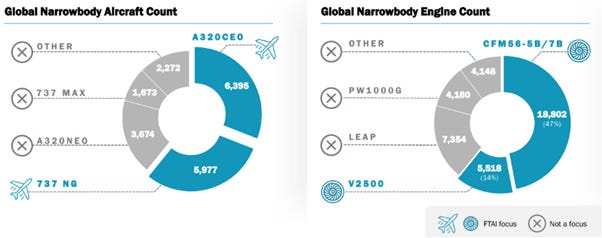
FTAI is an independent engine maintenance business that focuses on the CFM56-5B, CFM56-7B, and V2500 aircraft engines (which power the Boeing 737NG and Airbus A320ceo aircraft). These engines cover around 60% of commercial narrowbody jets.
In other words, FTAI’s repair activities revolve around the CFM56 engine, which is the best-selling commercial jet engine family in history, with more than 33,000 engines delivered to date (according to Safran, which manufactures the CFM56 engines jointly with GE Aerospace in a 50/50 joint venture). The fact that FTAI has focused specifically on the most popular engine will be relevant when we look at the nature of FTAI’s competitive advantage.
Source: Company filings
At a high level, FTAI’s business is comprised of three segments:
Aerospace Products (92% of revenue and 74% of segment EBITDA in Q2 2026) – this is the company’s core MRE business which performs the engine exchanges. It supplies refurbished engines and modules to airlines and aircraft owners, taking that customer’s engine in exchange.
Aviation Leasing, including the Strategic Capital Initiative (SCI) (8% of revenue and 26% of segment EBITDA in Q2 2026) – this segment is transitioning from an on-balance sheet lessor to an asset-light manager of third-party capital:
Under SCI, FTAI raises closed-end vehicles from institutional investors, co-invests a minority slice, and earns management servicing fees in addition to a share in the returns. That capital is used to purchase aircraft and engines.
The inaugural vehicle, the 2025 SPV, raised $2 billion of equity and subsequently deployed $6 billion of capital across more than 300 aircraft. FTAI has now moved on to raising its second SPV and has stated an ambition to manage $20 billion of AUM (with this not seen as a ceiling).
Crucially, the engines within SCI are exclusively serviced by FTAI’s MRE program, creating captive demand for the Aerospace Products segment.
SCI has significantly changed the complexion of the Aviation Leasing financials, with recent segment EBITDA margins exceeding 100%. This is due to aircraft sold into the 2025 SPV no longer being recognized within lease income, and most of what the segment earns from SCI does not flow through revenue, with FTAI’s pro-rata share of the equity-accounted SCI income being added back to adjusted EBITDA.
FTAI Power (pre-deliveries, so currently not generating any revenue or EBITDA) – this business converts run-out CFM56 cores into mobile gas-turbine generator sets for data centers. The business is slated to start its first deliveries later in 2026.
We will spend most of the report looking at the Aerospace Products and FTAI Power segments.
The anatomy of a CFM56 engine
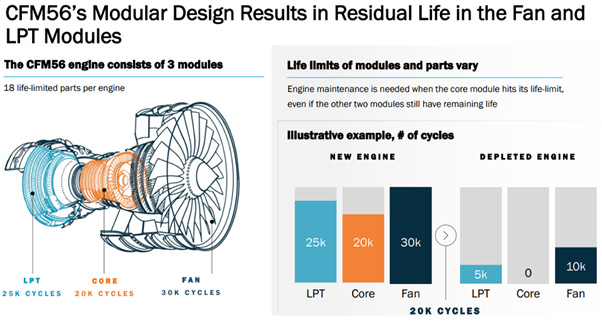
FTAI’s value proposition is to optimize green time for customers (i.e., the usable life left on an engine), minimize aircraft downtime, and to do so at an attractive cost. To understand this, it is worth highlighting that a CFM56 engine can be separated at bolted flange interfaces into three modules:
The fan and booster at the front;
The core (high-pressure compressor, combustor and high-pressure turbine); and
The low-pressure turbine at the rear.
And in each CFM56 engine there are 18 life-limited parts, such as the disks, spools and shafts whose failure could send high-energy fragments through the engine casing. The regulators set a hard cycle limit for each of these LLPs.
As can be seen below, a brand new CFM56 engine will have different amounts of remaining cycles for each of the three modules.
Source: Company filings
In this sense, there’s a mismatch of remaining cycles amongst the various modules. The three modules age at different rates and their remaining cycles are almost never in step. What this means is that an engine is “run-out” – that is, it has exhausted its usable operating life – when one of the three modules depletes its cycles, irrespective of the number of cycles remaining for the other modules.
At this point, airlines would historically send their own engines to an independent or OEM MRO shop, which restores it and returns the same engine to the airline.
How a conventional MRO shop visit works
An MRO will disassemble the customer’s engine, figure out the scope of work and what parts need to be used for the engine refurbishment, and then repairs or replaces parts to support an agreed target operating period (which typically accounts for engine condition and the remaining life of components, as well as the amount of flying expected during the rest of the lease and any lease-return requirements).
The problems with an MRO shop visit are as follows:
The turnaround times are lengthy (roughly 120-200 days), and these turnaround times have increased materially since pre-COVID. For example, AerFin in June 2026 estimates that a CFM56 full overhaul takes 90-120 days, compared to about 60 days pre-pandemic[1]. And for narrowbody-engines, Oliver Wyman estimated in April 2026 that turnaround times were regularly reaching 180-200 days for many operators. This is critical, because the longer it takes for your engine to be repaired and returned by an MRO, the longer the aircraft downtime (or more likely, the longer the period over which an airline must rent a spare engine to keep the plane in the air, which obviously adds to costs).
Many MROs have good relationships with the OEMs, and in order to maintain these relationships (particularly when it comes to being licensed to repair newer generation engines such as the LEAP), there is a strong incentive to use the more expensive OEM parts in a repair. Some MRO shops will not use the much cheaper Parts Manufacturer Approval (PMA) parts when repairing an engine, at risk of upsetting the OEMs. One expert we heard from who previously worked at StandardAero, an MRO, mentioned that they wouldn’t use PMA parts (although when checking StandardAero’s terms of service, it does appear that PMA use is permitted with a customer’s approval). An MRO’s use of OEM parts results in a more expensive repair cost, especially when we consider that 80% of the repair cost is comprised of materials (as opposed to labor).
There is the potential for workscope creep – that is, additional issues are discovered once the engine is disassembled and inspected. This often results in the final bill ending up larger than what the customer had expected (anyone who has taken a car to a mechanic can likely attest to this practice and the frustrated feeling when the sticker shock hits!)
FTAI’s value proposition
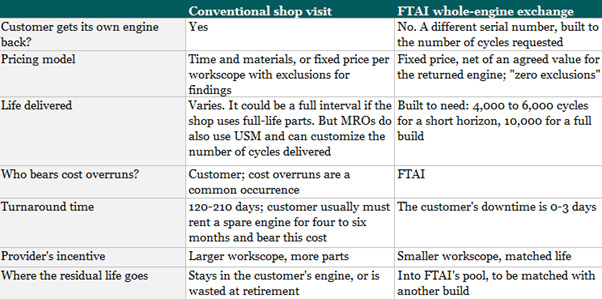
FTAI approaches engine repair differently to a conventional MRO shop. Rather than repairing and returning a customer’s engine, FTAI will exchange that engine for a refurbished replacement. In this sense, FTAI has commercialized and scaled a Maintenance, Repair, and Exchange (MRE) model. This model is enabled by the fact that FTAI owns a pool of engines as well as the repair facilities (and is the only company to do this at any meaningful scale). We have mapped out the differences between the two models in the table below.
Source: Bristlemoon Capital; company filings
FTAI’s model has a number of advantages. It allows faster engine replacement for airlines, greater cost certainty, and lower maintenance costs. FTAI is able to charge its customers less for an engine with a given level of cycles because it has a cost advantage.
FTAI’s cost advantage comes from two areas: 1) used serviceable materials (USM), whereby FTAI can repair engines from parts within its inventory of engine modules; and 2) Parts Manufacturer Approval (PMA) parts, which are demonstrably cheaper than OEM parts and can lower the material costs for an engine repair.
Green time optimization via FTAI’s pool of modules
The first advantage revolves around what FTAI calls green time optimization. Recall that green time is the remaining useful life in an engine or module before further maintenance or replacement is required. And as we covered earlier in the report, an engine can become unserviceable if just one module has exhausted its remaining life, even if the other two modules have thousands of cycles remaining.
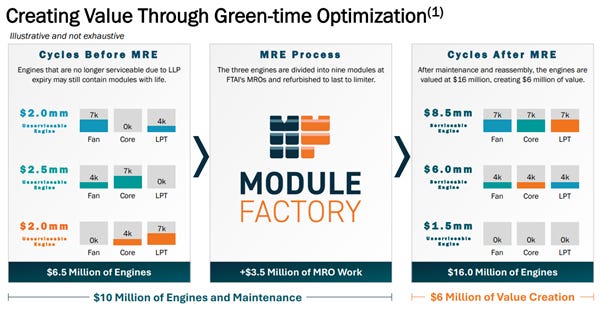
What FTAI does is refurbish any usable modules in the CFM56 engines it procures (either via a swap or acquisition) and then combines them with modules from other engines to produce a replacement engine with a similar life across the three major modules. The following example provided by the company is helpful in illustrating the value that FTAI adds via its module swap program.
In the illustrative example there are three unserviceable engines worth a combined $6.5 million, each with varying remaining cycles for each of the three modules. And crucially, all three engines are unserviceable given that in each engine one of the modules has depleted its cycles. FTAI can reconfigure these modules to create two serviceable engines that are comprised of modules with equal remaining cycles. In the process, the combined value of the three engines increases to $16 million, leading to $6 million of value creation when accounting for the $3.5 million of MRO work to refurbish the engines.
Source: Company filings
It’s worth noting that the value of those modules always existed within those unserviceable engines. It’s just that FTAI’s MRE model provided a means to reconfigure those modules between engines and release that latent value, creating two serviceable engines that go back on wing and keep those planes flying.
FTAI’s advantage in executing this MRE model is driven by the enormous pool of engines, and thus modules, that the company owns. For example, as of Q4 of 2025, FTAI had 539 engines (494 of which were from the CFM56 and V2500 families), which decomposes into 1,617 modules (remember, there are three modules per engine). Think of it as a game of mix and match where you’re trying to put together the optimal combination of modules to meet a customer’s needs.
For example, a module with 5,000 cycles remaining would be unsuitable for a customer who wants an engine with another 10,000 cycles. But that same module would be perfect for a different customer who is planning to retire an aircraft after 5,000 cycles and wouldn’t have a need for additional cycles beyond that. So, the larger the inventory of modules, the greater the number of combinations, and thus the more opportunities FTAI has to find an appropriate match and avoid the need to buy new parts. In fact, combining modules is entirely a scale game, with the number of combinations of modules rising exponentially as the number of aircraft engines increases.
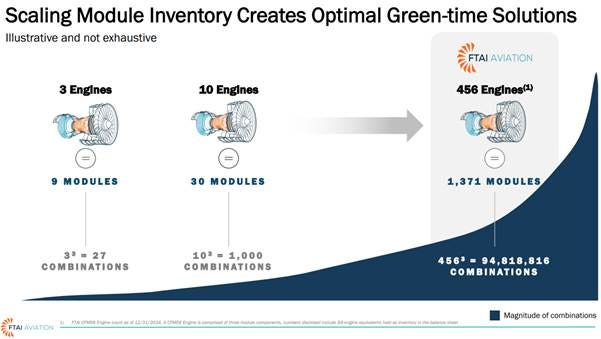
Source: Company filings. Note that the 456 CFM56 engine count is as of December 31, 2024.
The stock of modules with mismatched remaining cycles was created over twenty years by conventional maintenance, which might reset one module while leaving the other parts used. FTAI’s value add is in arbitraging the green life left in these modules, facilitated by the company’s enormous pool of engines. We will explore later in the report some of the risks around this model.